Post-FTD Drop-Off to Sustainable Retention
How do you fix post-FTD drop-off when acquisition is already working?
Post-FTD drop-off is a retention architecture problem, not a traffic or product failure. When players deposit once and disengage, the cause is an unstructured post-conversion lifecycle — not a weak funnel. Solving it requires building retention infrastructure that keeps players returning by choice, not by incentive.
Acquisition was working just right. This online casino operator had built a healthy traffic engine. Registrations were strong. First-time deposits were consistent. The top of the funnel was doing its job.
But downstream, the lifecycle was breaking.
In a classic case of post-FTD drop-off, players were depositing once and then going silent. Revenue looked stable on the surface, but beneath it, value was leaking. This case study shows how Converst transformed that pattern by turning inactive accounts into repeat depositors and building a sustainable retention engine without relying on short-term incentives or artificial spikes.
The Situation: Strong Acquisition, Weak Post-FTD Retention
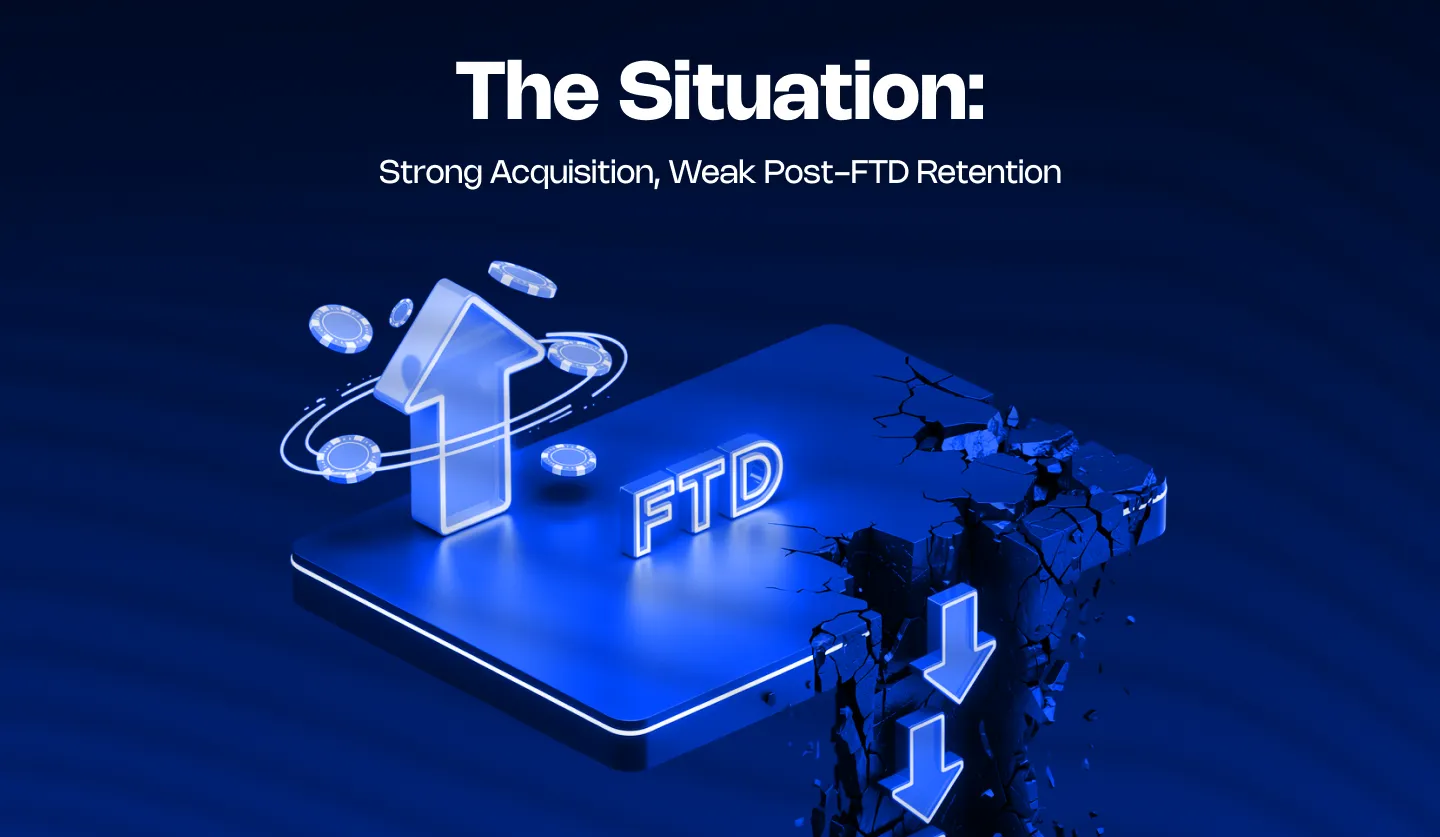
The operator's acquisition strategy was delivering volume. First-time deposit conversion was healthy. The entry point into the ecosystem worked, but the issue appeared immediately after.
New depositors were not transitioning into active, returning players. Instead, they completed a single transaction and disengaged. Registrations without sustained activity do not build margin. They inflate acquisition cost and compress lifetime value.
This is where many brands misdiagnose the problem. They look at traffic, bonuses, or product gaps. The breakdown was in post-FTD retention.
Without structured lifecycle management, even the strongest acquisition funnel becomes a revolving door. The result is predictable: high churn, unstable revenue curves, and constant pressure to replace lost players with new ones.
The Objective: Sustainable Return, Not Temporary Uplift
A short-term incentive push could have generated immediate uplift. That was not the objective.
The goal was sustainable behavioral return. Players who come back by choice. Players who re-engage with the brand beyond a single offer.
There is a clear distinction between stimulating deposits and building loyalty. When dormant player reactivation relies purely on incentives, it often produces inflated short-term metrics followed by accelerated churn.

The objectives were defined clearly:
- Increase player activity
- Drive repeat deposits
- Improve brand loyalty
- Strengthen long-term retention metrics
This was not about launching another campaign. It was about correcting the retention architecture.
The Converst Approach
Converst implemented its proprietary Converst-R Reactivation Model — a framework built on more than a decade of iGaming lifecycle management across operator types, markets, and database conditions.
The model does not rely on generic scripts or volume outreach. It is structured around long-term player behavior rather than short-term stimulus.
Three principles define the approach.

Individual engagement, not list management. Databases do not reactivate. People do. The model treats each inactive account as an individual with a specific engagement history, behavioural profile, and re-entry point — not as a record in a segment to be messaged at volume.
Behavioral alignment over offer timing. The objective is not to catch a player at the moment they might redeposit. It is to re-establish a relationship that makes redepositing a natural next step — on the player's terms, not the operator's campaign calendar.
Retention continuity built in from the start. Reactivation that feeds players back into an unstructured lifecycle simply reopens the churn cycle. The model is designed so that re-engaged players enter a retention environment that supports continued activity — not just a single return transaction.
Adapting to Real Conditions
The client's database was not perfectly segmented. The lifecycle structure was not built for advanced automation. Converst adapted to those conditions and delivered results regardless.
This matters because most retention initiatives are designed for ideal inputs. Real operator environments rarely are. Effective dormant player reactivation does not require a clean starting point — it requires a methodology built to perform without one.
What Changed
The performance shift was measurable.
Reactivation rates increased. Dormant accounts returned to activity. Deposit frequency improved. Engagement depth expanded.
More importantly, the retention curve stabilised.
Instead of short-term spikes followed by rapid decline, lifecycle value became more consistent. Players who re-entered the ecosystem continued engaging beyond a single transaction.
This was not incentive-driven churn presented as growth. It reflected genuine behavioral return.
Post-FTD retention strengthened because returning players resumed interaction rather than executing isolated deposits. Revenue became less dependent on acquisition pressure and more supported by recurring value.
The defining outcome was predictability.
What This Case Proves About Reactivation
Reactivation is often treated as a campaign. Sustainable results require treating it as retention infrastructure.
When post-FTD retention is unmanaged, lifetime value compresses. When dormant player reactivation is handled strategically, leakage slows, LTV expands, and lifecycle predictability improves.
Within broader iGaming lifecycle management, reactivation is not an isolated activity. It is a structural component of margin protection.
In iGaming, retention is margin.
A sustainable casino player retention strategy does not rely on perpetual incentives. It builds a system where players return because the relationship remains active and relevant.
Acquisition creates opportunity. Retention creates profit.
Conclusion
The operator's acquisition funnel was not the constraint. Traffic volumes were strong. First-time deposits were consistent.
The performance gap emerged after conversion.
The solution was not another short-term campaign. It was retention infrastructure. The post-FTD lifecycle shifted from reactive performance to structured retention, restoring long-term stability and strengthening recurring value.
If post-FTD drop-off is a recurring pattern, it is not random. It is structural — and it is solvable. [Link to What We Offer / Contact]
FAQ
What is player reactivation in iGaming?
Player reactivation in iGaming refers to re-engaging previously active users who have become inactive or stopped depositing. The goal is to restore consistent activity and protect lifetime value — not to generate a single redeposit, but to bring players back into a lifecycle that continues.
How do you reactivate dormant casino players?
Effective dormant player reactivation starts with treating players as individuals rather than database records. Generic incentive campaigns can produce short-term deposits, but they rarely restore sustained engagement. The more durable approach is one built around individual behavioral profiles and lifecycle continuity — re-establishing the relationship, not just triggering a transaction.
What is the difference between player retention and player reactivation?
Player retention is the ongoing work of keeping active players engaged. Player reactivation is the process of bringing inactive players back. The distinction matters because they require different approaches — but they are not separate disciplines. Reactivation that isn't connected to a broader retention strategy tends to produce players who churn again quickly.
Why do players stop depositing after the first deposit?
Post-FTD drop-off is almost always a lifecycle management issue, not a product or acquisition failure. When there is no structured engagement framework in place after the first deposit, players disengage by default. The acquisition funnel delivered them. The retention architecture was not there to keep them.