How to Reactivate High-Value Dormant Players: A Framework for Casino Operators

High-value dormant players require a different reactivation strategy because their silence signals revenue risk, not typical churn. They don’t respond to automation the way the general base does. When a VIP goes silent, generic CRM flows miss the deeper reasons. These players expect context, relevance, and real communication—human-led conversations that rebuild trust and unlock meaningful LTV recovery.
The data shows that for this segment, human-led outreach consistently outperforms automated paths. When trained agents can read the situation, adapt the message, and resolve friction directly, reactivation becomes far more predictable and cost-efficient. This is the area where Converst has built deep expertise: structured conversations, native-language communication, and disciplined follow-up designed specifically for high-value recovery.
What follows is a practical, operator-ready framework grounded in real outcomes: a method you can apply immediately to recover dormant value efficiently and sustainably.
Why High-Value Dormant Players Deserve Their Own Reactivation Strategy
High-value players require a dedicated reactivation strategy because their inactivity reflects individualized behavioral shifts that generic CRM systems cannot interpret or address.
Most operators understand the economics: a small cluster of high-value players drives a disproportionate share of NGR and long-term margin. What’s less visible is how differently these users behave when they go silent, and why applying general CRM logic almost always damages value.
Effective high value player reactivation begins with a strategic shift: VIP inactivity is not a broad marketing task. It is a revenue-risk signal that requires targeted, human-led intervention.
High-value players follow distinct behavioural rhythms, react to different triggers, and expect communication that reflects their history, preferences, and importance. When operators run dormant VIPs through mass automation, engagement collapses, bonus spend inflates, and true LTV recovery becomes harder. A tailored VIP reactivation strategy is not an extra mile, but the operational foundation for protecting NGR and unlocking sustainable reactivation ROI.
Why VIP churn hurts more than average churn
VIP churn has outsized financial impact because their inactivity removes disproportionate contribution relative to the overall player base.
A dormant VIP removes both immediate revenue and future earning potential. One high-value user can equal the output of hundreds of casual players, which means each day of inactivity compounds into meaningful NGR loss. Strong VIP and high roller reactivation restores trust, intent, and contribution, making player LTV uplift a more important metric than simple winback counts.
Why mass campaigns fail for high-value segments
Mass campaigns underperform with VIPs because standardized messaging cannot match the personal context or expectations of this segment.
Dormant VIP players rarely respond to:
- Generic or template-based messaging
- Promotions irrelevant to their preferred games
- Automated reminders lacking human nuance
These players expect context and discretion. They engage with conversations, not campaigns, which is why more operators rely on trained, human-led teams.
The hidden cost of treating VIPs like the general base
Applying general-base tactics to VIPs carries hidden costs by misaligning communication with their behavioral and value profile.
Misaligned outreach erodes value. Each irrelevant touchpoint increases bonus waste, lowers future responsiveness, and accelerates permanent churn. Precision protects margin, safeguards relationship equity, and creates the conditions for profitable VIP player reactivation.

Defining a High-Value Dormant Player in Your Casino CRM
A high-value dormant player is defined by measurable historic contribution paired with a break from their normal behavioral rhythm.
High-value dormant players share two attributes: they generate meaningful, repeatable contributions and they have broken their expected activity rhythm. Strong reactivation performance starts by identifying those two signals with precision while relying on method and data, not guesswork. When operators anchor “high value” in measurable behaviour and “dormant” in clear deviations from historical patterns, outreach becomes targeted, margin-safe, and focused on players with real LTV recovery potential.
Value signals: deposits, NGR, and frequency
Value signals help identify players whose consistent activity patterns indicate predictable, repeatable contribution.
High-value players reveal themselves through consistent behavioural and financial patterns rather than single moments of large spend. Typical signals include:
- Sustained deposit volume and rhythm
- Material NGR contribution relative to cohort size
- High betting frequency or significant stake levels
- Clear product, channel, or session-time preferences
- Past responsiveness to personalized or human-led communication
Operators should avoid defining VIPs through one-off spikes. Reliable value is found in pattern, intent, and predictability, the traits that make high value player reactivation both measurable and scalable.
Dormancy windows: when a VIP is truly at risk
A VIP becomes at risk when their personal activity cadence deviates in a way that suggests interruption rather than natural fluctuation.
Dormancy is not a fixed timeline; it is a break from expected behaviour. For some high-value players, a gap of 5 to 7 days signals immediate risk. For others, longer cycles like 20, 30, or even 40+ days may be normal.
Dormancy Indicators and What They Look Like in Practice
A VIP becomes at risk when their personal activity cadence deviates in a way that suggests interruption rather than natural fluctuation.
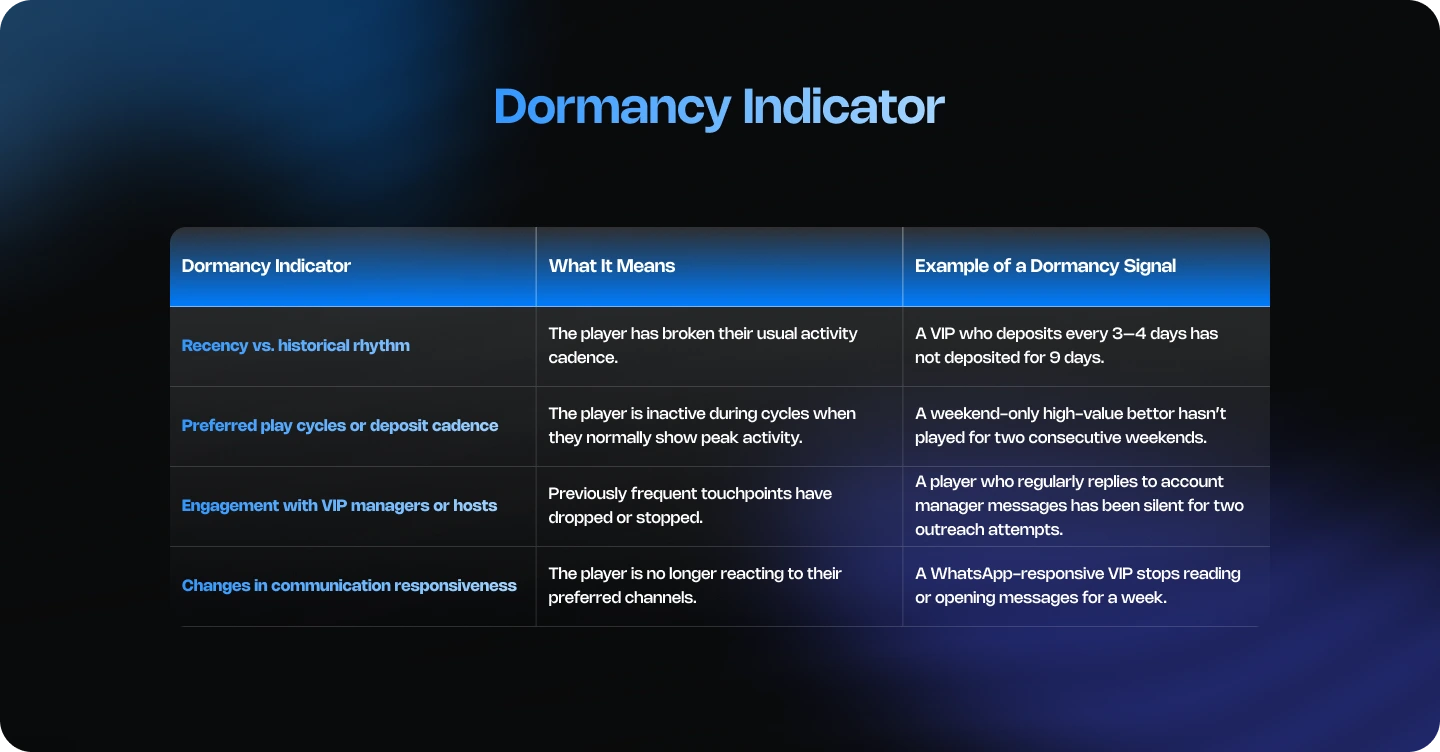
When a player’s natural rhythm breaks, the risk curve accelerates. This is the moment where targeted VIP player reactivation should begin.
Step 1: Identify and Prioritize High-Value Dormant Segments
Effective prioritization begins by evaluating who shows meaningful historical value and whose recent behavior indicates realistic recovery potential.
Effective high value player reactivation begins with prioritization. Dormant VIPs do not share the same intent, urgency, or revenue potential, and treating them as a single group leads to wasted effort and inflated bonus exposure. The most reliable approach is to classify players using two core signals: their historical value pattern and the degree to which they’ve broken their personal activity rhythm. When these signals are read together, they form a practical, operator-ready framework for deciding who to contact first.
Dormancy Prioritization Flow
Decision Point 1: Historical value
→ Does the player show sustained deposit rhythm, meaningful NGR contribution, and consistent stake behaviour?
• If yes → Move to the next decision point
• If no → Deprioritize; low ROI probability
Decision Point 2: Deviation from personal rhythm
→ Has the player broken their typical deposit or play cadence?
• Minor deviation → Recently dormant high-value segment
• Significant deviation → Continue assessment
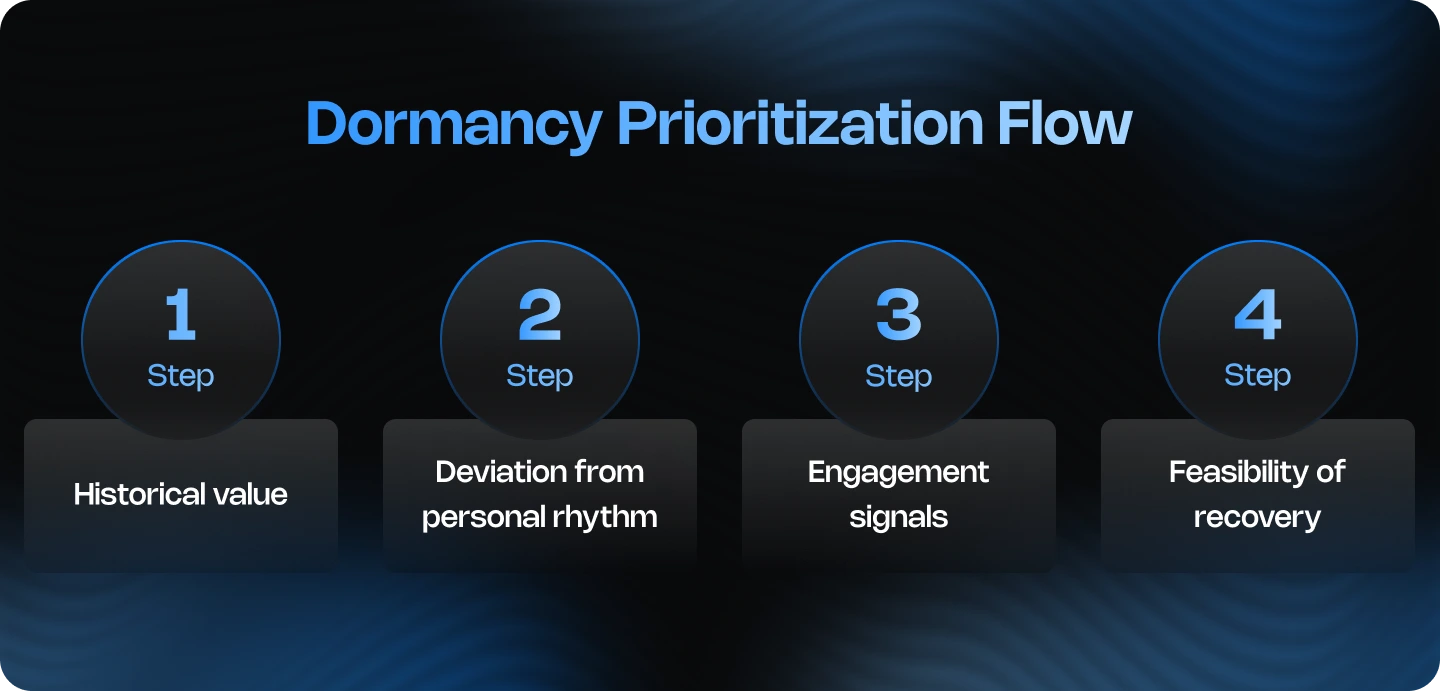
Decision Point 3: Engagement signals
→ Has responsiveness on preferred channels or with VIP hosts declined?
• Partial drop-off → Mid-term dormant segment
• Full drop-off → Continue assessment
Decision Point 4: Feasibility of recovery
→ Does historical behaviour still reflect loyalty or long-term potential?
• Yes → Long-term dormant high-value segment (selective outreach)
• No → Low-priority / disengage
These directional segments help operators, or a performance-based reactivation partner, focus effort where the probability of meaningful LTV uplift is highest. The objective is not to contact everyone; it’s to recover value efficiently while protecting margin.
Step 2: Design Human-Led Outreach That Feels Like Concierge, Not Call Center
Human-led outreach is essential because it adapts in real time to personal cues, creating communication that feels relevant and intentional.
Automation can deliver scale, but it cannot rebuild trust. Dormant VIPs expect to speak with someone who understands their habits, speaks their language, and can interpret hesitation or frustration in real time. This is why effective VIP player reactivation depends on human-led outreach — not templated CRM flows. Native-language agents can pick up emotional cues, adjust pacing, and personalize the conversation based on the player’s history and tone. That adaptability is what turns a contact attempt into a meaningful recovery moment.
What a VIP reactivation conversation should sound like
A high-quality reactivation conversation should establish rapport quickly while uncovering friction points through natural, adaptive dialogue.

Strong conversations feel natural and context-aware. The agent acknowledges the player’s past behaviour without overstepping, asks targeted questions to surface friction, and adapts the discussion as signals shift. The goal is clarity and confidence, not pressure. Value is presented simply, and next steps are shaped around the player’s preferences. This is where trained teams outperform generic scripts — by recognizing hesitation, identifying root causes, and guiding the interaction with judgement rather than rigid flows. Converst’s CONVERST-A methodology formalizes that skill set so teams can deliver consistent, situation-aware conversations at scale.
Channels VIPs actually respond to
VIPs favor communication channels that provide immediacy, privacy, and personal interaction.
High-value players prefer channels that feel personal and controlled:
- Phone calls for relationship-level dialogue
- WhatsApp, Viber, or Telegram for quick, low-friction follow-ups
- Personalized email for confirmation or offer clarity
- SMS for short reminders or check-ins
Human-led outreach works because it meets players where they are: on the channels they trust, in the language they prefer, with conversations that feel like concierge service rather than scripted calls.
Step 3: Build a Reactivation Offer That Protects Margin and Feels Exclusive
A strong VIP reactivation offer balances personalization with controlled exposure to ensure motivation without unnecessary cost.
A large offer alone is less likely to tempt high-value players that can receive it anywhere. They are more likely to consider taking advantage of an incentive that feels personal, relevant, and easy to activate. The challenge for operators is to build offers that motivate action without eroding margin, especially in a segment where bonus misuse or overspending can quietly drain profitability. The strongest reactivation offers feel exclusive while staying tightly aligned to the player’s natural behaviours.
A high-impact VIP reactivation offer should be built on four pillars:
- Relevance: Match the offer to the player’s preferred games and typical stake levels.
- Simplicity: Keep terms clear and friction low; dormant VIPs do not engage with complex mechanics.
- Fairness: Ensure the value feels proportionate to the player’s history and aligned with their expectations.
- Margin Safety: Personalize within defined exposure limits tied to expected LTV recovery, not past peak spend.
Once these pillars are in place, the offer becomes a strategic tool, not a cost centre. The most effective incentives are not the biggest, but the ones that reflect genuine understanding of the player’s habits. A blackjack-first VIP noticing a tailored table-games offer feels recognized. A high-stakes bettor receiving a clean, low-friction reload sees intent, not a generic promotion. That relevance creates momentum long before the bonus is claimed.
For operators, the value lies in precision. The right offer strengthens the human-led conversation, signals exclusivity, and supports reactivation without unnecessary bonus exposure. When executed well, it feels like recognition, which is the exact sentiment that brings dormant VIPs back.
Step 4: Execute with a Structured Cadence and Objection Handling
A structured cadence ensures each interaction has a defined purpose and moves the player closer to re-engagement.
Reactivation succeeds when outreach is consistent, coordinated, and respectful. VIPs respond best to communication that feels intentional and a structured cadence gives teams a clear path to follow while allowing room for human judgement.
Example VIP reactivation cadence
A realistic, high-performing cadence typically moves through four stages:
- A personalized check-in conversation that resets the relationship and surfaces friction.
- A follow-up on a secondary channel to keep the interaction light and familiar.
- A clarification or friction-removal touchpoint focused purely on resolving the blocker uncovered earlier.
- A final, concise offer that reflects the player’s history and gives them a simple path back.
Each touchpoint should feel purposeful. If a message doesn’t add new context or clarity, it shouldn’t be sent.
Common objections from dormant VIPs and how to respond
Objections from dormant VIPs usually signal underlying issues that need clarification before reactivation can occur.
Dormant VIPs tend to voice similar concerns, but each carries a deeper signal. Comments about poor service typically reflect a break in trust. Payment or verification frustrations indicate operational friction that halted momentum. When players say promotions “aren’t interesting,” it’s usually a relevance gap rather than a value issue. And when a VIP feels overlooked, the relationship itself needs repair. Skilled agents treat these objections as openings: they clarify expectations, remove the blocker, and rebuild confidence through calm, contextual conversation.
How trained agents turn objections into progress
Skilled agents convert objections into progress by interpreting them as indicators of unmet needs rather than rejection.
Objections are not rejections, they are signals. Skilled agents use them to diagnose the real barrier. A VIP frustrated by verification wants reassurance and speed. A player who “didn’t see anything interesting” needs a relevant, personalized angle. When handled correctly, objections become openings to rebuild confidence, remove friction, and guide the player back into an actionable next step.
Step 5: Measure Reactivation ROI, Not Just Response Rate
Measuring ROI rather than surface engagement ensures reactivation efforts are evaluated based on true commercial impact.
Reactivation performance is defined by the value recovered. Operators should anchor their evaluation in metrics that directly reflect commercial impact. The core indicators include reactivation rate, deposit uplift, NGR recovered, and LTV uplift. These metrics show whether outreach is generating meaningful business outcomes rather than surface-level activity. Cost-to-reactivation and overall margin integrity complete the view, ensuring the effort remains profitable at scale.
Where this becomes particularly powerful is in Converst’s performance model. Instead of paying for attempts or labour hours, operators pay only when real results are delivered. The structure is simple:
- Performance-only pricing tied to measurable outcomes
- No acquisition fees and no lifetime rev-share
- Real-time dashboards showing uplift, ROI, and segment-level contribution
- Bulletproof data protection and onboarding completed within one week
This alignment removes guesswork and keeps every action tied to commercial value. The outcomes speak for themselves. Across operator portfolios, Converst’s structured, human-led reactivation methodology consistently drives:
- 450%+ ROI across high-value segments
- 85% retention after 12 months among reactivated VIPs
- 96% CSAT, supported by 24/7 native-language concierge teams
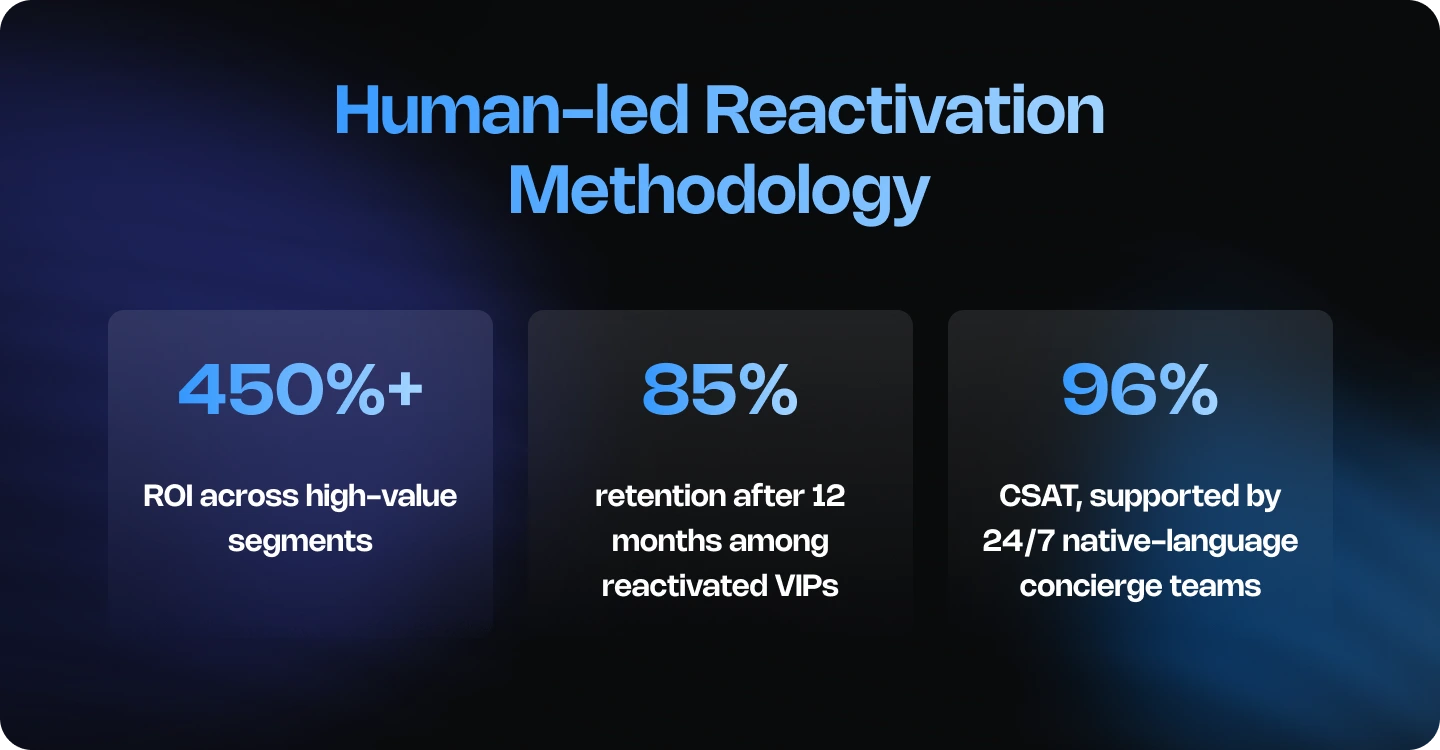
These results reflect a model built on operational precision, not broad CRM activity. When operators track the right metrics and partner under terms that link cost directly to performance, reactivation stops being a discretionary initiative and becomes a predictable revenue engine.
When to Stop Chasing a High-Value Player
Operators should pause reactivation when continued contact shows diminishing returns or conflicts with risk and compliance considerations.
A disciplined reactivation strategy requires not only knowing how to pursue dormant VIPs but also knowing when to stop. High-value players matter, but they are not all recoverable — and chasing indefinitely can erode margins, strain operations, and introduce unnecessary compliance risk. Stepping back at the right moment is a sign of control, not failure.
The clearest signal to disengage is complete non-response across a full, structured cadence. When a player has been contacted through multiple channels, at different times, with personalized and friction-removal touchpoints, persistent silence indicates either a lack of intent or a deliberate decision not to engage. Continuing beyond that point adds cost without increasing the probability of recovery.
Other indicators that it’s time to abort reactivation efforts include:
- Repeated avoidance or explicit disinterest
- Responsible gaming or fraud-related red flags
- An unfavourable value-to-effort ratio
- Behavioural patterns consistent with permanent churn
Knowing when to disengage protects your brand, your team, and your margins. It ensures the reactivation engine stays focused on players with genuine potential — the ones who deliver measurable, sustainable ROI.
In many cases, stopping outreach is not a failure at all. It is a smart, strategic decision that safeguards brand equity, operational resources, and regulatory alignment.
Case Snapshot: Turning Dormant VIPs into Incremental Revenue
This case demonstrates how targeted, insight-driven outreach can re-engage silent VIPs efficiently and responsibly.
- Segment
An operator approached Converst with a cohort of high-value players who had been dormant for several weeks. These users had historically generated strong, predictable value, but multiple automated CRM attempts had produced almost no engagement. The operator needed a targeted, human-led approach capable of uncovering the real reasons behind the silence. - Approach
Converst re-segmented the group using behavioural indicators such as responsiveness history, preferred products, and deviations from normal activity rhythms. Using these insights, our team executed a structured outreach cadence: an initial check-in to diagnose friction, a follow-up on a secondary channel to maintain continuity, and a margin-safe offer aligned with each player’s established preferences. The focus was on resolving the underlying blockers, not increasing promotional spend. - Outcome
As soon as the outreach shifted to personalized conversations, agents quickly uncovered small frictions and preference mismatches that hadn’t surfaced through automated channels. By addressing these nuances and re-establishing a sense of relevance and recognition, previously inactive VIPs began re-engaging. The return was driven by clarity and trust, not by aggressive incentives.
Directional impact:
• Reactivation across a meaningful share of the targeted segment
• Deposit levels rising by a clear uplift vs. pre-dormancy
• ROI turning positive within days
These results align with Converst’s broader VIP Concierge performance: 85% 12-month retention, 96% CSAT, and an average 450% ROI across high-value segments.
Conclusion
High-value reactivation isn’t guesswork, it’s a sequence.
First, define what “high value” and “dormant” mean in your CRM.
Then prioritize the segments with the strongest recovery potential.
From there, use human-led outreach that feels like concierge service, not automation. Pair it with margin-safe, relevant offers and run a structured cadence that uncovers friction rather than repeating reminders.
Finally, measure what matters: reactivation rate, deposit uplift, NGR recovered, and long-term LTV impact.
When these steps align, reactivation becomes a predictable, profitable engine that strengthens relationships while recovering meaningful revenue with minimal waste.
Ready to see what your dormant VIP base is really worth?
Share a few anonymized segments, and Converst will prepare a free high-value reactivation forecast outlining expected ROI, timing, and the uplift you can realistically expect.
FAQ
How do you define a high-value dormant player in iGaming?
A high-value dormant player combines material historical NGR or deposit value with a break in their expected activity rhythm. Definitions differ per operator but typically rely on patterns, not just time inactive.
How long should a player be inactive before you try reactivation?
The correct window depends on the player’s historical rhythm. For highly active VIPs, reactivation may begin within a short silence; for long-cycle bettors, the window may be longer. Behavioral deviation is the most important indicator.
What channels work best for reactivating VIP casino players?
Human-led channels like calls, messaging apps, and personalized email show the highest conversion. Dormant VIPs engage when outreach feels personal, contextual, and respectful.
How do you measure ROI on a high-value reactivation campaign?
Measure recovered deposits, NGR uplift, LTV uplift, and net ROI after bonus and operational costs. Converst provides dashboards that show these metrics transparently through a performance-only model.
Why use a managed reactivation partner instead of handling it in-house?
Dedicated teams bring experience, multilingual capability, structured cadences, and proven methodologies. Partners like Converst deliver results without adding headcount. Operators pay only when performance is achieved.