iGaming HR Trends in 2026: What Operators Need to Know
HR trends in iGaming in 2026 are being shaped by six forces:
- AI adoption in recruitment workflows
- tightening talent supply in compliance and tech roles
- pay transparency regulation
- the shift to skills-based hiring
- borderless workforce models
- a growing demand for employer brand credibility.
Each carries direct implications for how operators attract, retain, and develop the teams behind their player experience.
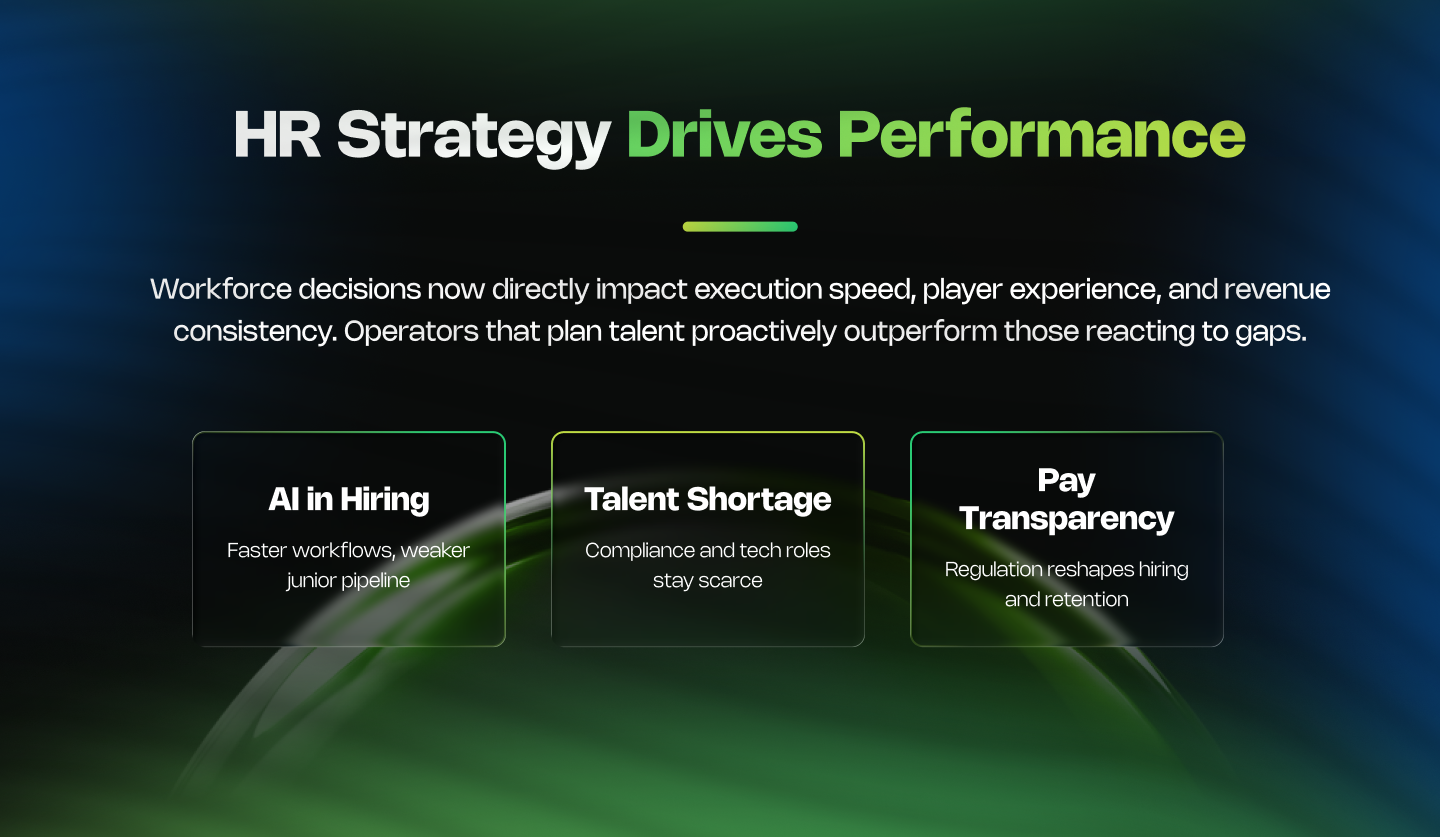
These trends act as operational levers, influencing cost control, execution speed, and the consistency of player experience. For operators, workforce strategy now sits at the core of performance.
Why HR Strategy Has Become an Operator Priority
HR strategy is now a critical operational lever. The iGaming industry has shifted from rapid expansion to operational maturity. Success is no longer defined solely by market entry but by flawless execution, which relies on the availability, quality, and stability of talent.
Operators that rely on reactive hiring face measurable consequences. Talent gaps persist, hiring cycles for specialist roles extend for months, and internal teams absorb extra workload, driving cost volatility. The 2025 iGB/Pentasia Salary Survey reported average salary growth of 4.09%, the strongest increase in three years, illustrating the sustained competition for experienced professionals in tech, compliance, and data functions.
This talent pressure directly impacts player-facing operations. In support and retention teams, slow hiring translates into longer response times, inconsistent communication, and missed opportunities to engage and retain players. Workforce stability is no longer optional; it is a determinant of operational performance, revenue predictability, and regulatory readiness.
HR is now both a performance driver and an operational risk. Proactive workforce planning, strategic talent retention, and targeted recruitment are essential to maintain service quality and protect revenue outcomes.
The 6 HR Trends Defining iGaming in 2026
These six iGaming HR trends define how operators will compete in 2026, shaping hiring speed, talent availability, compliance readiness, and the consistency of player-facing operations.
1. AI Is Reshaping Recruitment and Creating a Mid-Level Pipeline Problem
AI in recruitment is transforming iGaming hiring workflows. Automated tools now handle CV screening, candidate matching, and initial outreach, improving efficiency, reducing time-to-hire, and enabling HR teams to process higher volumes of applicants with fewer resources. These efficiency gains address immediate operational needs but also drive structural changes in the workforce.
Entry-level hiring is declining as AI reduces reliance on roles that traditionally support high-volume recruitment and early-career development. Operators are increasingly prioritizing mid-to-senior candidates who already possess iGaming experience. The SOFTSWISS and Pentasia iGaming Talent Trends 2026 report shows that 84% of respondents consider prior iGaming experience essential for B2B roles, and 65.2% for B2C roles, reflecting the rising demand for experienced professionals.
The consequence is a predictable mid-level pipeline risk. Fewer junior hires today mean fewer professionals gaining hands-on experience to progress into mid-level roles in three to five years. Product, data, CRM, and player engagement teams are most directly affected, creating operational gaps and iGaming recruitment challenges.
Operators that focus solely on short-term efficiency and experienced talent risk long-term shortages. Strategic workforce planning must balance AI-driven efficiency with the maintenance of a junior pipeline to support iGaming employee retention and sustained operational performance.
2. Compliance and Tech Talent Remain the Hardest Roles to Fill
Compliance and tech roles remain the most difficult positions to recruit in iGaming. Regulatory expansion across LatAm, MENA, and Ontario has increased demand for specialists, but supply cannot keep pace. Operators face longer hiring cycles, higher salary premiums, and persistent gaps in critical functions.
The SOFTSWISS and Pentasia iGaming Talent Trends 2026 report highlights that 39.1% of respondents identify compliance and AML roles as the hardest to fill in B2C operations, illustrating the scarcity of qualified candidates. In newly regulated markets, such as Ontario’s regulated sports betting launch, operators struggled to secure local compliance experts with AGCO licensing knowledge, delaying market entry and increasing operational risk.
Tech talent shortages are equally pressing, with prior iGaming experience often mandatory for both B2C and B2B roles. These gaps directly affect product development, CRM systems, data-driven player management, and the ability to scale operations across multiple jurisdictions.
Operators must address these iGaming recruitment challenges proactively, building pipelines for compliance and tech specialists and implementing retention strategies for existing teams. Securing these roles is critical for regulatory readiness, operational stability, and consistent player-facing performance in both B2C and B2B functions.
3. Pay Transparency Is No Longer Optional
The EU Pay Transparency Directive, effective June 2026, requires iGaming operators to adopt clear and accessible compensation practices. Companies with 100 or more employees must report gender pay gaps, provide employees with information about individual remuneration, and disclose salary ranges to candidates without being asked. Non-compliance carries regulatory and reputational risk.
Operators will need to integrate pay transparency into job postings, interview processes, and internal HR systems. If the average gender pay gap exceeds 5% in any employee category, companies must justify differences using objective criteria and implement corrective measures within six months. Joint pay assessments with employee representatives are required to address and prevent disparities.
For iGaming operators, the directive affects talent acquisition, employee retention, and employer brand credibility. Clear salary practices are now a baseline expectation for candidates and a regulatory requirement for EU operations. Preparing in advance ensures that HR teams can manage compliance while maintaining consistent hiring workflows and avoiding legal penalties.
Integrating transparent pay frameworks is no longer optional. Operators that act proactively will mitigate compliance risk, support iGaming employee retention, and strengthen their reputation in a candidate-driven market for both B2C and B2B roles.
4. Skills-Based Hiring Is Replacing the CV Filter
Skills-based hiring is the process of evaluating candidates on their demonstrated competencies rather than solely on formal credentials or CV history. In iGaming, this approach is increasingly applied to tech, data, and CX roles where practical ability drives performance and operational outcomes.
Traditional credential-based screening fails to address the skills gaps blocking transformation. According to the SOFTSWISS and Pentasia iGaming Talent Trends 2026 report, 63% of employers say skills gaps prevent organizational transformation, underscoring the need for competency-focused recruitment. Task-based interviews, work samples, and simulated problem-solving exercises are examples of practices operators are adopting to assess real-world capability.
Shifting to skills-based hiring strengthens iGaming employee retention by ensuring new hires can meet operational demands from day one. It also mitigates mid-level pipeline risk, supports team stability, and improves execution in product, data, and player engagement functions. Skills-focused recruitment is now essential to bridging talent gaps and sustaining performance in iGaming operations.
5. Employer Brand Is Now a Talent Acquisition Tool
In iGaming, strong brand perception has become essential for attracting and retaining specialists in tech, compliance, and player engagement roles, where competition is high and candidates often have multiple offers.
NDA culture and the sensitivity of player-facing operations mean iGaming teams cannot rely on public profiles alone. Reputation for fair pay, career development, and operational excellence drives both recruitment and retention. Candidates increasingly assess employer credibility before applying, and poor perception leads to longer hiring cycles, higher turnover, and gaps in critical roles.
Team stability directly affects player experience. High turnover in support or engagement functions results in slower response times, inconsistent communication, and missed activation or reactivation opportunities. Conversely, a stable, well-perceived employer attracts experienced talent, reduces iGaming recruitment challenges, and enables consistent, high-quality player interactions.
Operators that invest in employer branding gain measurable benefits: faster hiring, improved employee retention, and more reliable execution across B2C and B2B teams. Employer brand is a strategic lever for workforce performance and player experience quality.
6. Borderless Hiring Is Standard, But Jurisdiction Complexity Is Real
Borderless hiring is increasingly standard in iGaming, enabling operators to tap into global talent pools for tech, compliance, and player engagement roles. This approach supports operational flexibility and access to specialized skills but introduces complexity in regulated markets with varying labor laws, tax regimes, and licensing requirements.
Operators hiring across jurisdictions must navigate differences such as employment contracts, social security obligations, and compliance certification requirements. For example, hiring a remote specialist in Romania may require adherence to local labor codes and taxation rules, whereas Malta or Gibraltar hires involve licensing alignment and local statutory benefits. Failure to comply exposes operators to legal penalties and operational delays.
Global recruitment strategies are also influenced by workforce availability and pay expectations. Some roles in high-demand regions may command salaries well above market averages, requiring careful compensation benchmarking and employer branding to attract the right talent.
Despite these challenges, borderless hiring remains critical for maintaining a stable, skilled workforce. Operators that implement clear jurisdictional compliance frameworks, standardized onboarding processes, and remote team management protocols gain access to top talent while minimizing operational risk, ensuring consistent player-facing performance and engagement across markets.
What These Trends Mean for CX and Player-Facing Teams
HR decisions in iGaming directly influence the quality of player-facing interactions. Staff turnover in support, engagement, and retention functions disrupts response times, reduces communication consistency, and delays player activation and reactivation campaigns. The operational reality is clear: HR instability translates to measurable impacts on player experience and revenue outcomes.
High voluntary turnover amplifies these effects. The Society for Human Resource Management (SHRM) benchmarks the average cost to replace an employee at 6 to 9 months’ salary, including recruiting, onboarding, and lost productivity. When turnover occurs in CX or engagement teams, operators face not only recruitment costs but also degraded operational performance, knowledge gaps, and delayed execution on critical player campaigns.
Skill gaps in tech, data, and player engagement roles further magnify the impact. Teams that cannot retain experienced professionals struggle with consistent execution of CRM strategies, reactive player support, and proactive reactivation initiatives. Each vacancy or abrupt departure cascades through remaining staff workloads, reducing morale and further increasing the risk of additional turnover.
To protect player experience, operators must prioritize workforce stability. Structured retention strategies, skills-based hiring, and proactive succession planning ensure that HR decisions support consistent, high-quality interactions. Turnover is not just an HR metric—it is an operational risk that directly affects engagement, retention, and reactivation performance.
How Operators Are Responding
Operators are responding to these HR trends by shifting from reactive hiring to structured workforce planning.
Leading operators are investing in internal talent development. Upskilling programs are used to build mid-level capability from existing teams. This addresses the pipeline gap created by reduced junior hiring.
Workforce planning is becoming proactive. Hiring for compliance roles often happens before market entry rather than after licensing. This reduces launch delays and regulatory risk.
Employer brand investment is increasing. Operators are improving transparency, showcasing company culture, and encouraging employee advocacy. This supports both recruitment and retention.
Skills-based hiring practices are being standardised. Task-based assessments and practical evaluations are now common in technical and CX roles.
Some operators are also restructuring compensation frameworks to align with pay transparency requirements ahead of the June 2026 deadline.
Operators that prioritize workforce strategy and understand the link between HR decisions and CX quality are better positioned to maintain high-performing teams and consistent player engagement. Learn more about how strategic HR alignment supports player experience and operational resilience at Converst Services.
Frequently Asked Questions
What are the biggest HR challenges facing iGaming operators in 2026?
The biggest HR challenges are talent scarcity in compliance and tech roles, the EU Pay Transparency Directive as a compliance deadline, and increased pressure on employer brand. Operators must compete in a candidate-driven market while meeting regulatory requirements and maintaining competitive, transparent compensation structures.
How is AI changing HR and recruitment in iGaming?
AI is automating screening and sourcing workflows, reducing time-to-hire and operational cost. It is also reducing junior-level hiring, which creates a structural risk. Fewer entry-level hires today mean a weaker mid-level talent pipeline in three to five years, particularly in tech and player engagement roles.
What does the EU Pay Transparency Directive mean for iGaming companies?
The EU Pay Transparency Directive requires salary range disclosure, employee access to pay data, and gender pay gap reporting. It applies from June 2026. iGaming operators in EU member states must update hiring processes, compensation frameworks, and reporting systems to remain compliant and avoid penalties.
Why is employer branding important for iGaming talent acquisition?
Employer branding influences both recruitment and retention in a candidate-driven market. Skilled professionals evaluate company reputation before accepting offers. In an NDA-heavy industry, visible signals such as employee reviews and public presence become critical for attracting and retaining talent.
How does staff retention affect player experience in iGaming?
Staff retention affects player experience because stable teams deliver consistent service and timely engagement. High turnover in support or engagement roles causes slower response times, inconsistent communication, and weaker relationships with players, reducing retention rates and lifetime value. Maintaining team stability ensures operational continuity and supports reliable player reactivation and engagement outcomes.