From registered user to repeat depositor: where conversion breaks down

Player acquisition in iGaming is more expensive than ever. Traffic volumes may still look healthy, but revenue efficiency tells a different story. The real issue isn’t how many users register, but how few ever become profitable players.
The gap between registration and repeat deposits is where value disappears. Users sign up with intent, stall before funding, or make a single deposit and vanish. This leakage silently erodes ROI and inflates acquisition costs. If you want to increase player conversion rate, this is the segment that matters most.
Sustainable growth depends on understanding how to increase player conversion across the early lifecycle from first deposit conversion to post-deposit engagement and a repeat deposit strategy that drives retention. Without clear lifecycle triggers, momentum breaks.
To increase player conversion rate at scale, operators need funnel visibility, measurable engagement, and proactive reactivation. Conversion is not a single event. It’s a sequence of decisions and this article breaks down where that sequence fails and how to fix it.
1. Mapping the Registration-to-Deposit Funnel
Most operators track registrations and deposits. Very few map the decisions players make between those two moments and that blind spot is where conversion performance collapses.
The registration-to-deposit funnel is a sequence of commitment checkpoints where intent either strengthens or decays. Each step introduces friction, uncertainty, or delay. When even one checkpoint fails, the probability of deposits drops sharply.
To increase player conversion rate, operators must define this funnel explicitly and measure each stage as its own conversion event. Treating registration-to-deposit as a single metric hides the real causes of drop-off and blocks optimization.
Core funnel stages

The most damaging drop-offs rarely happen at registration. They happen after intent is already proven and are caused by verification delays, missing local payment methods, or failed first deposit attempts. This is why UX changes alone rarely fix first deposit conversion.
If you are looking into ways to increase player conversion, stop optimizing endpoints. Start managing transitions. A mapped funnel turns opinions into data and data into revenue.
2. Why Players Drop Before the First Deposit
Players who register have already overcome acquisition friction. They’ve chosen a brand. They’ve shared personal data. At this stage, the goal is clear: first deposit conversion. Yet this is also where hesitation, doubt, and friction quietly destroy momentum. If you want to increase player conversion rate, understanding these failure points in depth is non-negotiable.
Onboarding friction slows intent
Lengthy registration flows, repeated data requests, and early mandatory KYC interrupt momentum. Each additional field or document request forces the player to reassess their decision. Intent decays with every pause.
Operators often underestimate how quickly motivation fades. Even small delays between registration and the next clear action significantly reduce the likelihood of funding. Removing friction here is one of the fastest ways to increase player conversion rate.
Trust is earned, not assumed
New players do not yet trust the platform. Unclear licensing, missing payment security indicators, or unanswered questions immediately raise doubt. A single moment of uncertainty can override the original intent to deposit.
Trust gaps directly impact first deposit conversion and long-term player retention. If players don’t feel safe funding an account, they won’t return later, regardless of what bonuses you offer them.
UX confusion kills momentum
After registration, many users don’t know what to do next. Too many games. Too many offers. No guidance. Choice overload leads to inaction.
Clear direction is a form of player engagement. When players understand where to go, what to play, and how to deposit, conversion rates rise. When they’re left to figure it out alone, intent stalls.
Payment friction ends the journey
Payment is the final and most fragile step. Failed transactions, missing local payment methods, unclear error messages, or slow processing instantly break trust.
Many operators lose players not because of price or product, but because payment problems are never resolved. Addressing payment friction is critical not only to first deposit conversion, but to any viable repeat deposit strategy.

3. First Deposit Engagement Mistakes
Many operators believe that once a player reaches the deposit screen, conversion is inevitable. In reality, this is where execution matters most and where costly mistakes undermine otherwise strong funnels. First deposit engagement requires aligning timing, message, and value with player intent. When this alignment breaks, first deposit conversion stalls and downstream player retention suffers.
H3 Poor timing erodes intent
Intent is fragile in the minutes and hours after registration. Messages sent too early feel intrusive. Messages sent too late arrive after motivation has cooled.
Many operators rely on fixed automation windows rather than behavior-based triggers. As a result, players receive prompts disconnected from their actual actions. Missed timing reduces the probability of any future engagement. Optimizing it is one of the most overlooked ways to increase player conversion rate, yet it directly impacts both first and repeat deposits.
Generic messaging ignores context
One-size-fits-all communication assumes all players register for the same reason. They don’t.
A sportsbook user receiving a casino bonus. A casual player pushed toward high-risk incentives. A local player offered irrelevant payment options. Each mismatch signals that the brand doesn’t understand the player. Contextual relevance is foundational to player engagement. Without it, even generous offers fail to convert.
Incentive misalignment weakens motivation
Bonuses drive deposits only when they are relevant.
Incentives that ignore player preferences, geography, payment behavior, or risk tolerance often delay action rather than accelerate it. Worse, they attract low-quality deposits that fail to support a sustainable repeat deposit strategy.
Effective first deposit incentives reinforce confidence and reduce hesitation. Poorly aligned ones introduce friction and doubt.
Over-reliance on automation removes trust
Automation scales volume, but it cannot resolve hesitation, confusion, or objections. When players encounter payment issues, KYC uncertainty, or simple questions, automated flows fall silent.
The absence of timely human support is one of the fastest ways to lose high-intent users. Human interaction builds trust, clarifies next steps, and salvages deposits that automation alone cannot.
4. Why One-Time Depositors Don’t Come Back
One-time depositors have already demonstrated trust and intent. They have overcome onboarding friction, completed a payment, and interacted with the product. When these players fail to return, the issue is rarely product quality. It is almost always a breakdown in player engagement and lifecycle management. If your objective is to increase player conversion rate, this segment deserves as much attention as pre-deposit users.
The post-deposit engagement gap
Most operators front-load effort around acquisition and first deposit conversion, then sharply reduce communication once the bonus is consumed. From the player’s perspective, the journey simply stops. Without a defined post-deposit path, players are left without direction. Silence signals indifference that kills player retention.
No segmentation, no relevance
One-time depositors are treated as a single group, despite having radically different behaviors and values. A low-stakes tester receives the same message as a high-intent bettor. A winning player is handled the same as a losing one.This lack of segmentation weakens any repeat deposit strategy.
Where repeat deposit strategies fail
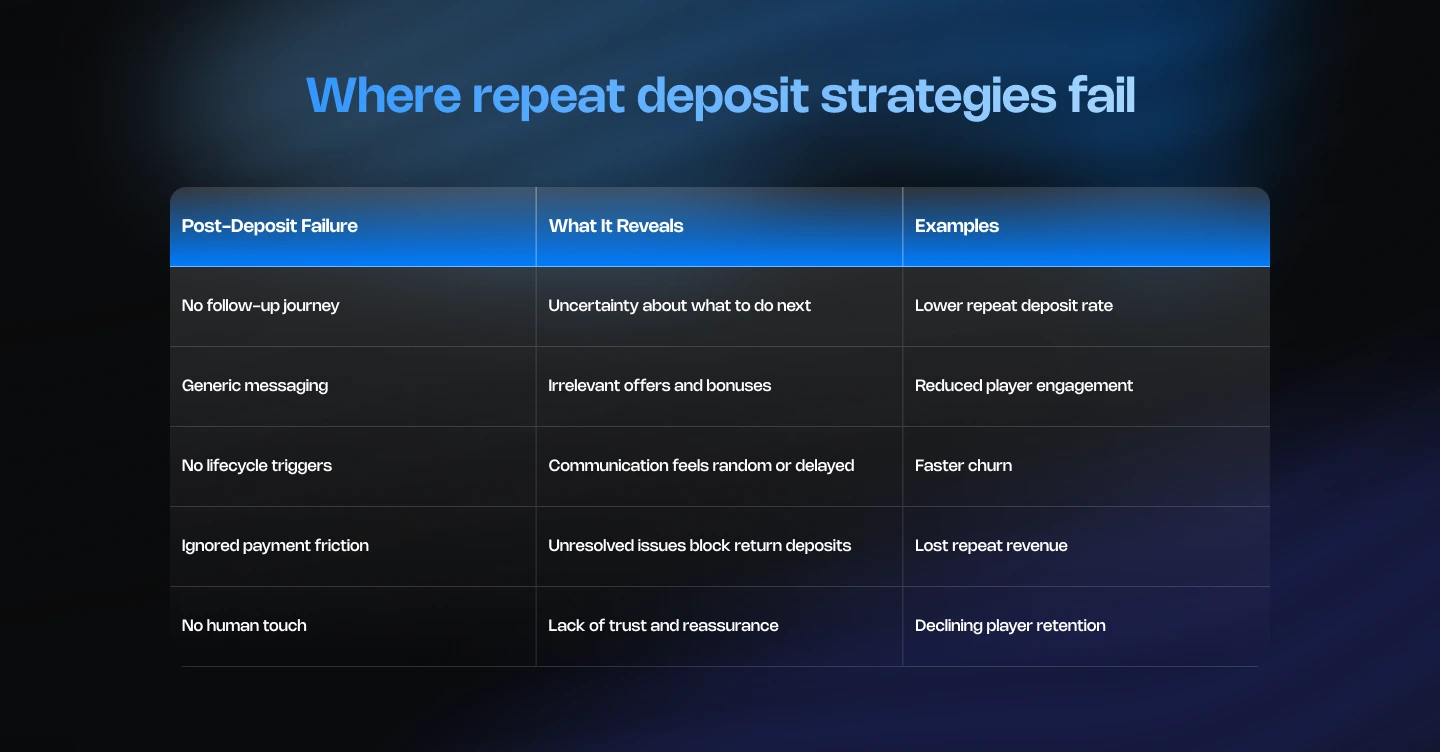
Repeat deposits are designed, not accidental
To increase player conversion rate, operators must treat the first deposit as the beginning of retention, not the end of conversion. Clear lifecycle triggers, segmented journeys, and responsive engagement transform one-time depositors into repeat contributors.
If you are asking how to increase player conversion, start where intent already exists. The fastest growth often comes not from new users, but from the players who were already willing to deposit once.
5. Using Reactivation to Drive Repeat Deposits
Reactivation is often misunderstood as a recovery tactic. In fact, it is one of the most efficient ways to increase player conversion rate without increasing acquisition spend.
Players who registered but never deposited or players who deposited once and disappeared have already demonstrated intent. They entered the funnel, trusted the brand, and engaged. The journey stopped not because demand vanished, but because something broke. Reactivation exists to capture that stalled intent and convert it into revenue.
When executed correctly, reactivation strengthens player engagement, improves long-term player retention, and becomes a foundational element of any scalable repeat deposit strategy.
High-impact reactivation focuses on:
- Failed or abandoned payment attempts
- KYC or verification uncertainty
- Loss-related frustration after first deposit conversion
- Inactivity caused by unclear next steps
By resolving these blockers, operators restore momentum. This is why reactivation consistently improves first-to-second deposit rates and overall lifecycle value.
Human-led reactivation restores confidence
When a player hesitates due to payment friction, uncertainty, or losses, human interaction changes outcomes. Native-speaking agents can explain issues, guide next actions, and reframe value in real time. This reassurance is often the deciding factor between churn and return.
From a lifecycle perspective, human-led reactivation shortens the gap between intent and action which is a critical driver in how to increase player conversion beyond one-time deposits.
Reactivation as a conversion multiplier
Reactivation should not be treated as a last-resort churn tool. When embedded early, it acts as a conversion multiplier across the funnel.
Players who receive timely reactivation:
- Convert faster after registration
- Are more likely to complete a second deposit
- Maintain stronger ongoing player engagement
This makes reactivation one of the most cost-efficient ways to increase player conversion rate while simultaneously strengthening retention metrics.
Turning stalled journeys into repeat revenue
Operators often ask how to increase player conversion without relying on higher bonuses or more traffic. Reactivation is the answer hiding in plain sight.
By re-engaging users who already entered the funnel, operators turn sunk acquisition cost into incremental revenue. More importantly, they create continuity between first deposit conversion and long-term player retention.
To increase player conversion rate sustainably, reactivation must be built into the core lifecycle, not triggered only after churn becomes permanent.
6. Data and Measurement That Actually Matter
Most operators are not short on dashboards. They are short on insight. Vanity metrics like registrations, clicks, or bonus cost obscure the real question: where intent turns into revenue and where it breaks.
If you want to increase player conversion rate, measurement must follow player behavior across the lifecycle, not just marketing activity. Many reporting frameworks stop at acquisition or lump conversion into a single KPI. This hides friction and makes it impossible to understand how to increase player conversion in practice.
Without stage-level visibility, teams react too late. By the time churn appears in retention reports, first deposit conversion and early engagement have already failed.
Conversion metrics that move revenueMeasuring beyond the first deposit

Stopping measurement at first deposit conversion creates a false sense of success. One-time depositors inflate conversion metrics while quietly damaging long-term value.
To support a sustainable repeat deposit strategy, operators must track behavior after the first transaction:
- Time between first and second deposit
- Engagement activity following wins or losses
- Drop-off points during post-deposit journeys
This is where player engagement turns into player retention or disappears entirely.
To increase player conversion rate, data must be actionable, timely, and tied to lifecycle stages. Operators who treat data as an operating system, not a reporting exercise, convert more efficiently, retain longer, and scale revenue without scaling acquisition spend.
7. Building a Unified Conversion and Retention System
Most operators still manage acquisition, conversion, and retention in silos. Different teams. Different tools. Different KPIs. Players, however, experience one continuous journey. This fragmentation is a major reason operators struggle to increase player conversion rate despite strong acquisition volume.
Why disconnected systems break conversion
When onboarding, engagement, payments, and retention are handled separately, critical signals are lost. Marketing sees registrations. Payments see failures. Support sees complaints. No one sees the full picture.
The result is consistent:
- Delayed response to payment or KYC friction
- Generic engagement that ignores player context
- Missed reactivation after failed first deposit conversion
- Inconsistent experiences that weaken player engagement and trust
Without a unified view, teams struggle to understand how to increase player conversion across the lifecycle.
What a unified system enables
A unified conversion and retention system aligns data, engagement, and accountability around player behavior. It connects real-time funnel data, segmented activation and reactivation, and human-led outreach where automation fails. This ensures every interaction serves a measurable purpose.
Why Converst’s ecosystem model performs
Converst is built around this unified principle. Activation, reactivation, VIP, and support operate within a single performance framework. Every interaction is tracked. Every outcome is measured. Every campaign is optimized against revenue impact.
The result is not just higher conversion at one stage, but compounding gains across the funnel. To increase player conversion rate sustainably, operators don’t need more tools. They need one connected system designed around the player journey and accountable to results.
Conclusion: Unlocking Growth Between Registration and Repeat Deposits
In iGaming more traffic doesn’t always mean growth. True progress comes from converting existing intent more efficiently.
Between registration and repeat deposits sits the highest-impact opportunity to increase player conversion rate. This is where acquisition spend has the potential to compound into lifetime value.
Operators who win map the full funnel, remove friction before the first deposit, align engagement at the right moment, and treat reactivation as a core conversion lever. Most importantly, they connect conversion and retention into a single system designed around player behavior.
Request a performance assessment to identify where your funnel is leaking revenue and how much incremental growth is already within reach.
FAQ
How long does it take to improve conversion rates?
Early improvements to player engagement and first deposit conversion can be achieved within weeks once friction points and timing issues are addressed. Meaningful gains in player retention and repeat deposits typically compound over several months as lifecycle systems mature.
What metrics should operators track?
Operators focused on increase player conversion rate should prioritize:
- Registration-to-deposit (RtD)
- Time-to-first-deposit
- Deposit attempt vs. success rate
- First-to-second deposit conversion
- Cohort-based retention
These metrics reveal where intent breaks down and where intervention drives revenue.
How does reactivation impact conversion?
Reactivation directly improves first deposit conversion and second-deposit rates by addressing unresolved friction, payment issues, and trust gaps. When executed with segmentation and human engagement, reactivation becomes one of the most cost-efficient ways to increase player conversion rate while strengthening long-term retention.